Published by Ginninderra Press, 2017.
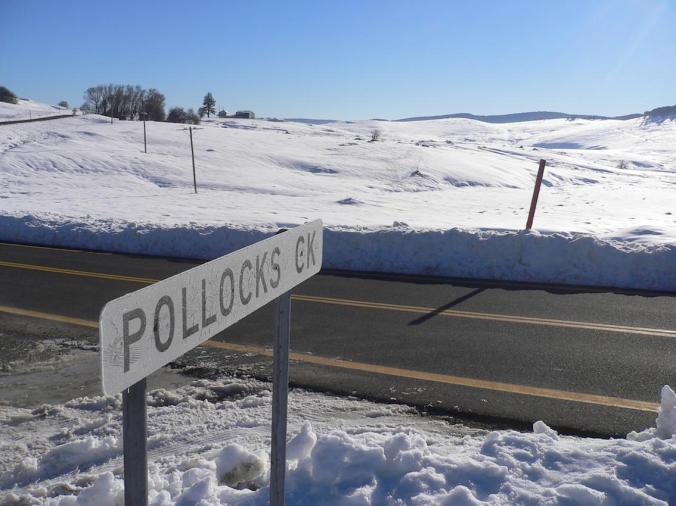
Snow at Kiandra © Matthew Higgins
opening lines:
“Somewhere in the howl of the morning blizzard there was another sound.”
…
Canberra historian, author and expert on the high country Matthew Higgins has published his first novel based on the ghost town of Kiandra. Kiandra is located in the New South Wales high country between Yarrangobilly and Adaminaby, and is now part of Kosciuszko National Park. The novel is told in the style of an oral history with Les Leong as our narrator, and this style makes the book very easy to read and accessible. We learn that Les was born an orphan in a terrific blizzard in 1891, and we follow his life story (mostly) in and around Kiandra.
I was surprised at some of the information Higgins reveals about Kiandra in his 158 pages. Via Les, we learn how Kiandra became the birthplace of skiing in Australia in the 1860s thanks to the Scandinavian migrants at Pollocks Flat; the vagaries of the physical conditions with huge blizzards (such as in 1891) and significant fires (such as in 1939); the Australian-Chinese tensions at various goldfields; the town’s treatment of the local Ngarigo, Wiradjuri and Wolgal people; the real-life characters drawn to Kiandra region such as photographer Charles Kerry, poet Banjo Patterson, author Elyne Mitchell, artist William Dobell and musician Mick Jagger; the impact that the Boer War, World War I and World War II can have on a small town; and the employment options for a town started on gold, but later relying on saw mill work and the Snowy Mountains scheme.
This is a delightful gem of a novel, with the author’s intimacy with and respect for the alpine region evident throughout the book. The cover image of children on their skis from around 1906 serves not only as a great front cover but is also possibly linked to one of the characters Les talks about, photographer Charles Kerry. Higgins’ writing reads well and so perfectly suits the oral history style of the book that I kept forgetting that I was reading a novel! Higgins gently reminds us how easy it is to forget just how much can happen in one lifetime – let alone one spent in a town which was abandoned in the 1970s, and how tough this community had to be to survive. A small but charming touch is the addition of pen and pencil sketches at the start of each chapter, and make sure to read the author’s note at the end of the novel.
‘Seeing Through Snow’ has an excellent sense of place, and I would highly recommend it to anyone wishing to gain an introduction to Kiandra or the Australian high country in general.
 a sense of place